Every thermal ends somewhere. The usual advice is to leave when it weakens: once the climb drops below what the day has been giving you, the next thermal is a better use of the time. A vario helps with that in hindsight. It tells you the climb of the last few seconds, and when the climb falls off, you are already there.
I wanted the FlyBeeper app to say how much is left before you get there. For that I first needed to know how a thermal ends. Does the lift fade over the last few hundred metres, so that a careful look at your own climb gives you a warning? Or does it keep going and stop?
The data
The same competition tracks as in the article about the thermal’s axis: every paragliding competition on airscore.fai.org with a working track archive, one fix per second, plus two of my own free-flying days at Kobarid. The circles of every pilot are grouped into thermals the same way: the gaggle is cut into ten-minute slices, and in each slice I take the axis that has the most circles around it. The axis article explains how.
For this question a thermal needs at least three pilots and 250 m of height between the lowest and the highest circle. That leaves 11,046 thermals: 4,158 in the mountains, 3,095 over hills and 3,793 over flat land, with 105,104 climbs in them and 597,530 full circles.
A climb here is one pilot’s circles in one thermal. The pilot leaves at the end of the last full circle. The top of the thermal is the height below which nine out of ten pilots left it — the few who went higher are left out, so that one lucky pilot does not set the top for everyone.
Pilots’ names play no part and do not appear anywhere below.
What the end looks like
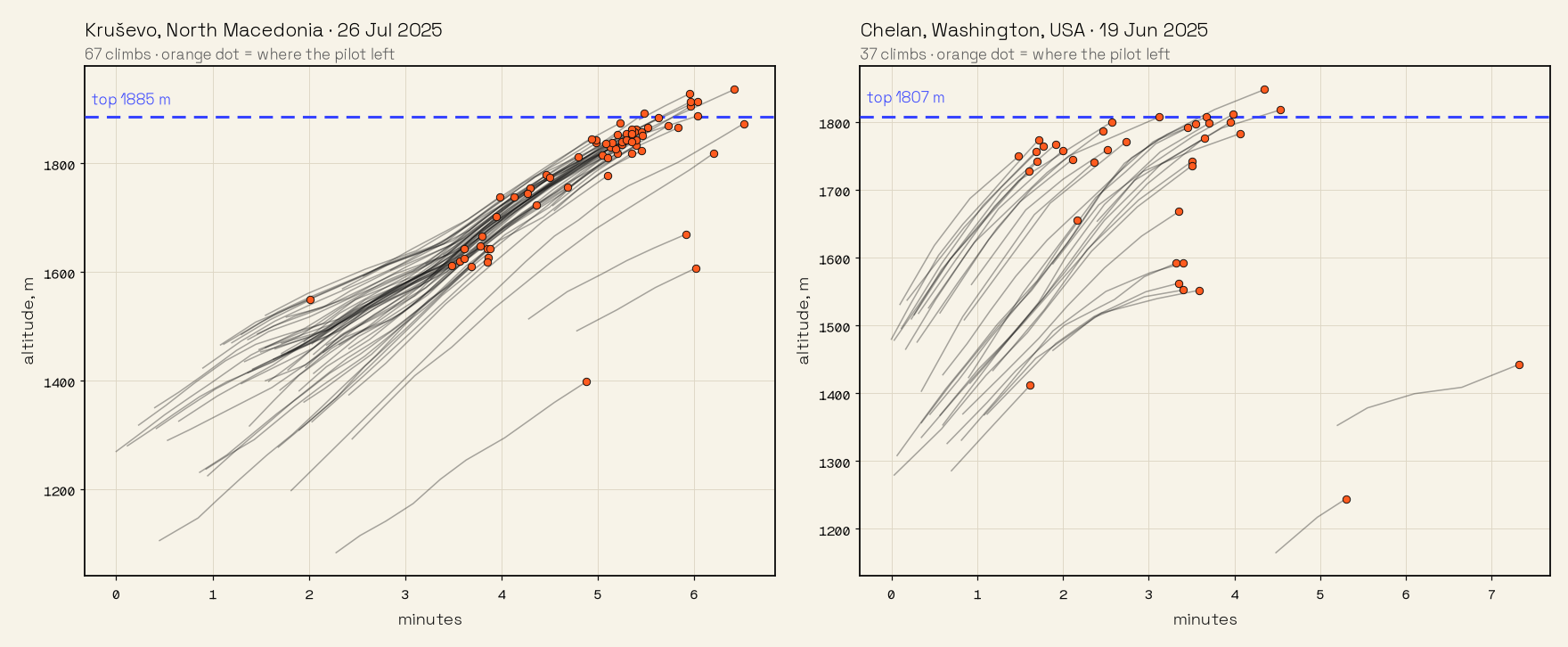
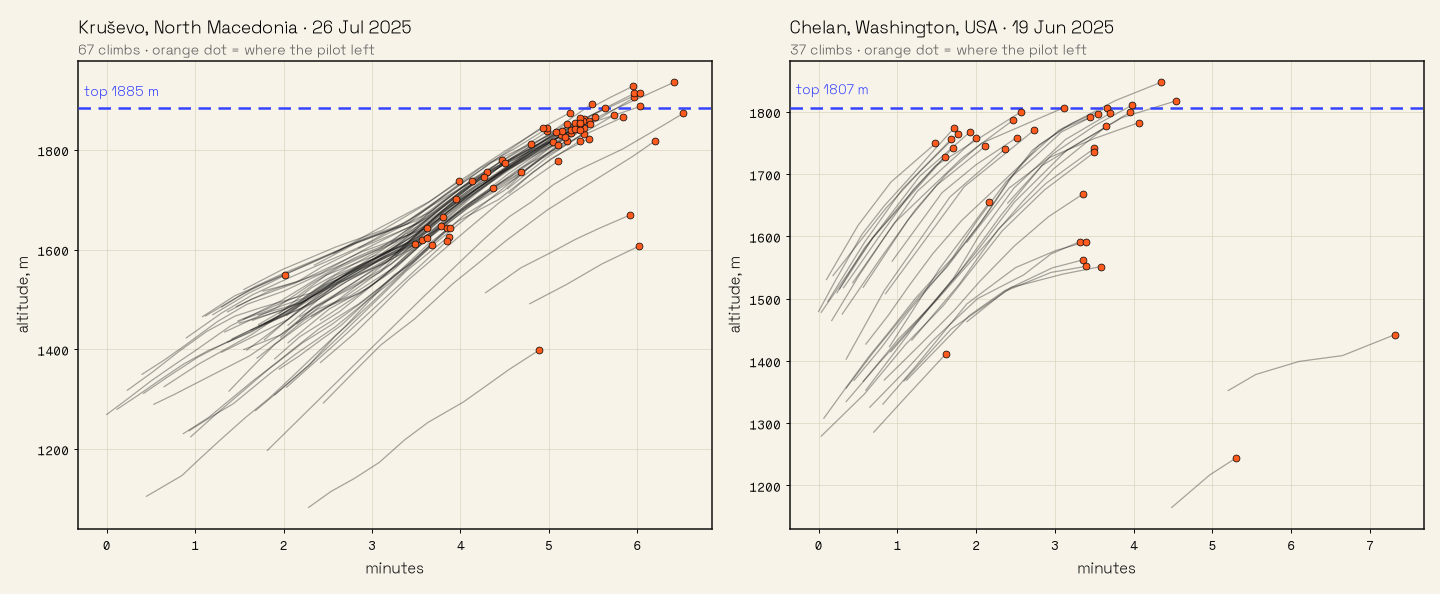
Kruševo on 26 July 2025, over flat land: 67 climbs, nearly all of them at the same rate right up to the line, and most of them leaving within fifty metres of each other. Chelan on 19 June 2025, a more rugged site: here the curves do bend over near the top, and the pilots spread out more. Both are real. The question is which one is typical.
The lift does not fade
For every circle I divided its climb by the typical climb of the same thermal — the median over the circles more than 250 m below the top — and grouped the circles by how far below the top they were.
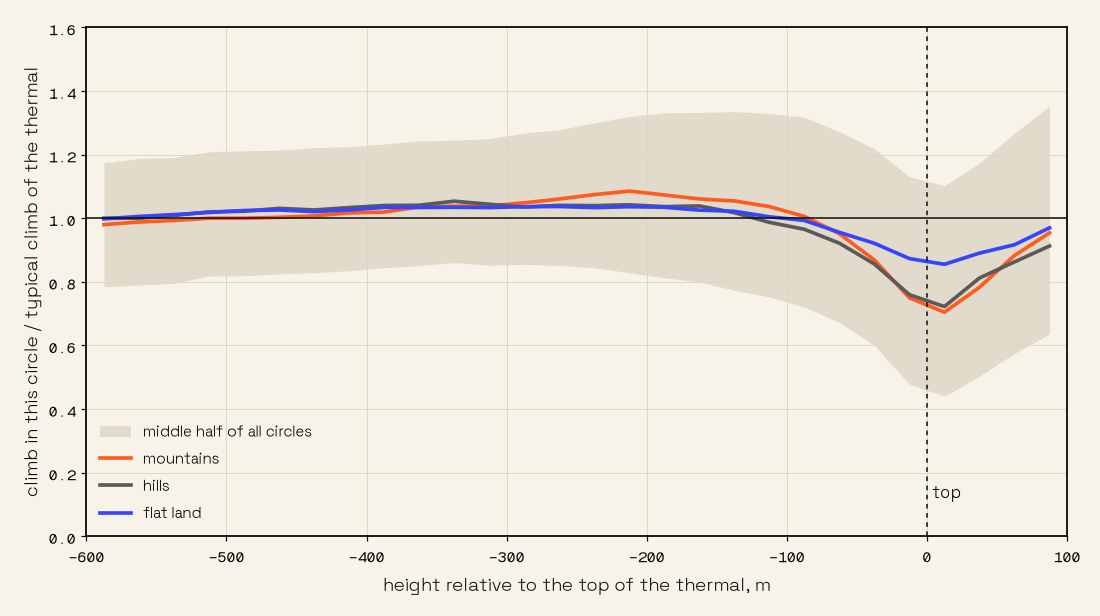
In the table, 1.00 is the typical climb of that thermal. The circles are counted in 50 m bands. The first two columns hold several bands each, so they show the lowest and the highest band, for example 1.02–1.04.
| Below the top | 500–300 m | 300–150 m | 150–100 m | 100–50 m | last 50 m |
|---|---|---|---|---|---|
| All thermals | 1.02–1.04 | 1.04–1.05 | 1.02 | 0.97 | 0.84 |
| Mountains | 1.00–1.04 | 1.06–1.08 | 1.05 | 0.98 | 0.82 |
| Hills | 1.03–1.05 | 1.04 | 1.00 | 0.94 | 0.81 |
| Flat land | 1.02–1.03 | 1.03–1.04 | 1.01 | 0.98 | 0.90 |
Medians. Up to a hundred metres below the top, the climb is what it was lower down — if anything a few per cent better. Over the last hundred metres it drops, but not by much: in the last fifty metres pilots still climb at 0.84 of the thermal’s usual rate, 1.3 m/s in absolute terms. Over flat land, 0.90.
That does not look like a thermal running out of energy. It looks like a ceiling. On a competition day that is most often the cloud base, sometimes an airspace limit; the tracks do not say which, but they do say that the pilots are leaving air that still goes up.
Two more numbers about the top. Within one thermal, the height at which pilots leave is tight: nine out of ten leave within 123 m of the median exit. And fewer than half of all climbs, 47 %, get within a hundred metres of the top. The rest leave lower, some for tactical reasons, some because they joined late.
Your own vario cannot see it coming
If the lift does not fade, your own climb says little about the top. I tried the obvious approach: fit a trend to the climb of your last circles and see where it would fall below 0.6 m/s. At 300 m below the top that gives an answer in only a quarter of the circles, off by 280 m. A warning set to sound 150 m before the top would fire in 42 % of the climbs that got within a hundred metres of the top. When it does fire, the pilot has a median of 47 m left to the top, 25 seconds before leaving. That is a vario telling you what you already know.
What does see it coming
The pilots around you. Two things turned out to work.
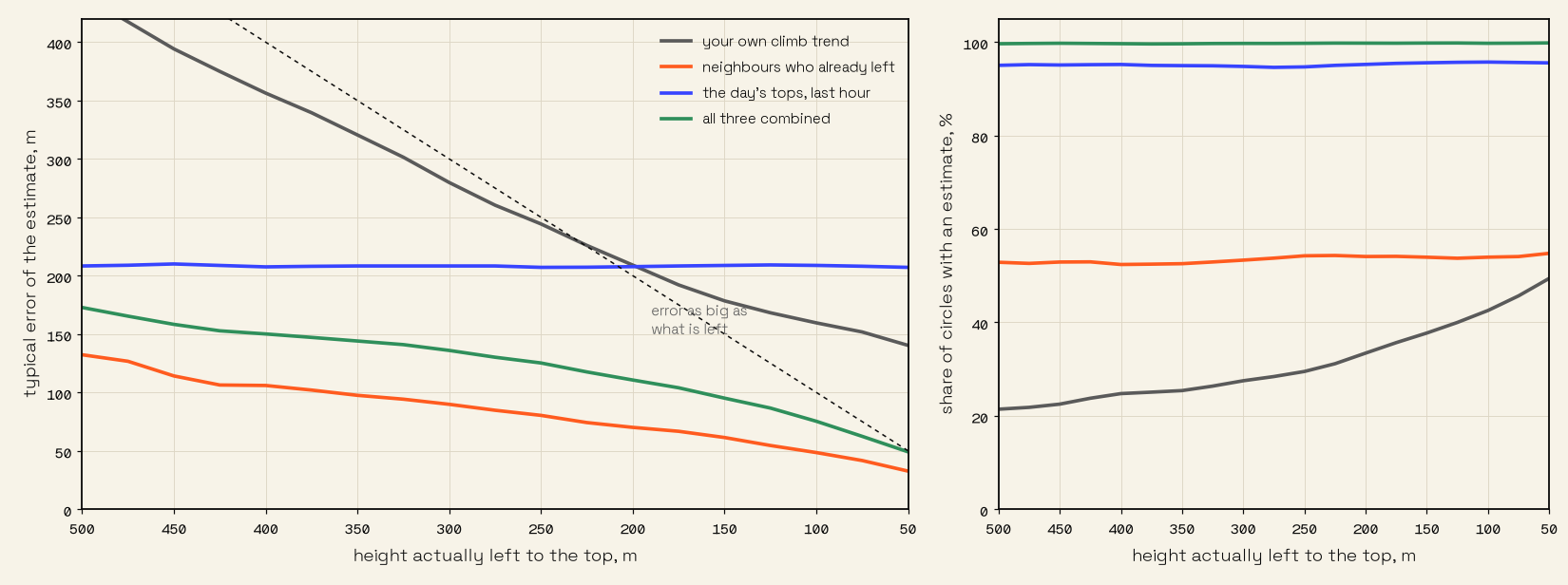
The first is the pilots who have just left your thermal. When someone in it stops circling and goes on glide, the height where they left is a sample of the top. The highest exit in the last five minutes is the best single estimate of all: 90 m off at 300 m below the top, 48 m off at 100 m. It is available in about half of the circles — you need someone who has already left above you.
The second is the day. The tops of the day’s earlier thermals within 20 km over the last hour tell you roughly where today’s ceiling is: about 200 m off, but available almost always. They work better as height above sea level than as height above the ground. That is what you would expect of a cloud base: it is flat, and the ground under it is not.
Put together, the combined estimate takes three steps:
- Take the highest exit from your thermal in the last five minutes, if there is one.
- If there is none, take the day’s typical top, as height above sea level.
- If a pilot still circling above you is higher than that, raise the estimate to their height.
In the table, ± is the median absolute error. Available is how often the estimate exists at all. It is a range because it changes with height: the first number is at 300 m below the top, the second at 100 m.
| Estimate of the height left | 300 m below the top | 200 m | 100 m | Available |
|---|---|---|---|---|
| Your own climb trend | ±279 m | ±210 m | ±160 m | 27–43 % |
| Pilots who already left (highest exit, 5 min) | ±90 m | ±70 m | ±48 m | 53–54 % |
| The day’s tops over sea level (1 h, 20 km) | ±208 m | ±207 m | ±208 m | 95 % |
| Combined | ±136 m | ±110 m | ±73 m | 100 % |
The same picture as the error falls towards the top:
A warning at 150 m
With the combined estimate, the same 150 m warning fires in 93 % of the climbs that got within a hundred metres of the top. The median height actually left when it sounds is 130 m (the middle half between 71 and 221 m), 72 seconds before the pilot leaves. In 7 % of them it sounds with more than 400 m still left to the top.
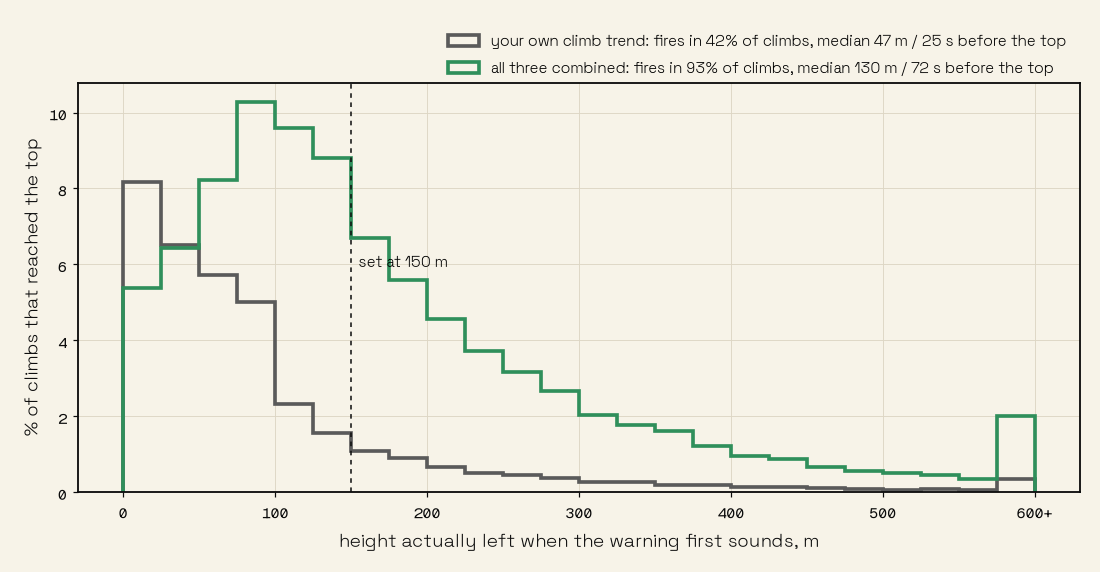
A minute is not much, but it is the minute that matters. It is time to decide where to go next, to pick up speed on the way out instead of on the last weak circle, and to leave fifty or a hundred metres before the gaggle without giving anything away.
Competition pilots mostly do this already. Over the last stretch before they leave, 38 % of climbs have a tail of circles weaker than the day’s average: 44 % in the mountains, 30 % over flat land. The day’s average here is the median climb rate of all that day’s climbs, not the typical climb of this thermal from the first table. Where there is a tail, it lasts about 50 seconds, and the pilot gains about 47 m of height in it. Good pilots do not waste much. What they have that most of us do not is a sense of where the ceiling is before they reach it.
In the app
The FlyBeeper app now does this, as part of the thermal assistant — for now an experimental setting, off until you switch it on. A cockpit cell shows the height left to the top of the thermal you are in and the time to get there at your current climb, with a mark for where the estimate came from: neighbours who left, the day, the forecast or your own climb. The day’s tops are kept on the phone until local midnight; the neighbours are whatever the FANET vario hears over FANET and ADS-L, plus pilots from the server when you are online. With nobody around, it falls back on the thermal ceiling of the weather forecast for the place and the hour — a number I have not tested against the tracks. When less than 150 m is left, the app says so — “Thermal top in 140 metres”, in English whatever the language of the app — or gives a short tone. The voice can be turned off.
Before the field, a replay: three competition days — Kobarid, Aksaray and Niš — fed into the app as if heard over the radio, with three pilots in turn as the one carrying the phone, ADS-L once a second and FANET every 10 and every 30 seconds. With pilots who had already left the thermal, the app’s estimate was off by 75–119 m over the whole climb; from the day alone, by 101–168 m. At 100 m below the top it was off by 67–103 m in seven of the nine runs and by about 150 m in the other two. At 300 m below the top it was off by 117 to 229 m. The combined estimate in the table above is off by 136 m there, so the best run was a little better than the table and the worst clearly worse. One pilot sees fewer exits above them than the whole gaggle does, and on a day when the tops rise towards noon the day’s typical top lags behind.
Limits
- The top is where the pilots left, not a measured cloud base. On competition days there is nearly always a base; on a blue day the picture may be different.
- Competition pilots leave for their own reasons: a start gate, a final glide, a leader to follow.
- The exits of neighbours only help once someone has left above you. The first pilot to reach the top has only the day and the forecast.
- The day’s typical top changes during the day. An hour-long window follows it, but late.
- Competition days are good days, with strong, busy thermals. A weak, lonely one late in the afternoon is not in this sample.
- The radio replay assumes everyone transmits and is heard; in the air some pilots carry nothing, and some packets are lost.