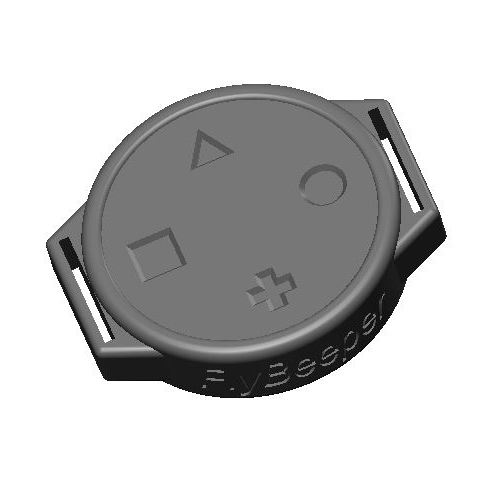
A small device that mounts on a paraglider’s brake handles or risers and lets you control flight apps remotely over Bluetooth via four tactile buttons. There is no power switch — the device is always available for a connection. It enters active mode when an app connects over Bluetooth, then drops back to deep sleep when the app disconnects. Battery life is measured in years.
Why this exists
Flight apps have finally started using the capabilities of modern Bluetooth — in particular, simultaneous connections to multiple peripherals. That makes it possible to split a flight rig into specialised devices: buttons on the brakes, a barometer hidden in the cockpit, an airspeed sensor lowered on a line, and a solar-powered FANET radio on the cockpit. Each of these devices can carry a power source matched to its consumption, with a service life measured in years.
Despite having multiple devices, none of them need a manual power switch. A device activates automatically when an app connects over Bluetooth (you start your flight app). When the connection drops (you exit the app), the device goes back to sleep, waking only briefly to remain discoverable. This regime lets a device run for years. Splitting the system also means you only buy what you need at a minimal price point, and you can add functionality incrementally.
Specifications
- 4 buttons
- CR2032 power (210 mAh, 3 V)
- Approximately 3 years of battery life (3.6 µA standby — closer to 6 years; 200 µA active — about 1,000 hours)
- Bluetooth LE 5 connectivity
- Industrial nylon case, 30 mm diameter, 8 mm tall, with two 12 × 1 mm lugs for mounting. The top cover carries icons above the four tactile buttons.
Hardware
The device is built on the energy-efficient Nordic nRF52. A circular PCB with the components on one side and a CR2032 battery holder on the other. Four miniature tactile buttons.
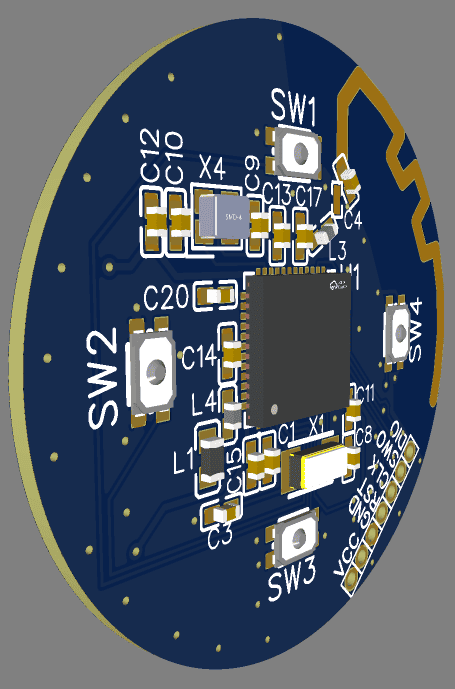 PCB top: nRF52 SoC and four miniature tactile buttons.
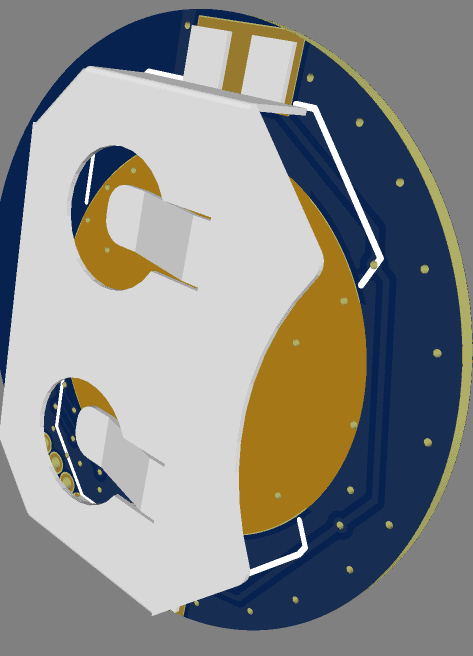 PCB bottom: CR2032 battery holder.
 First working prototype.
Firmware
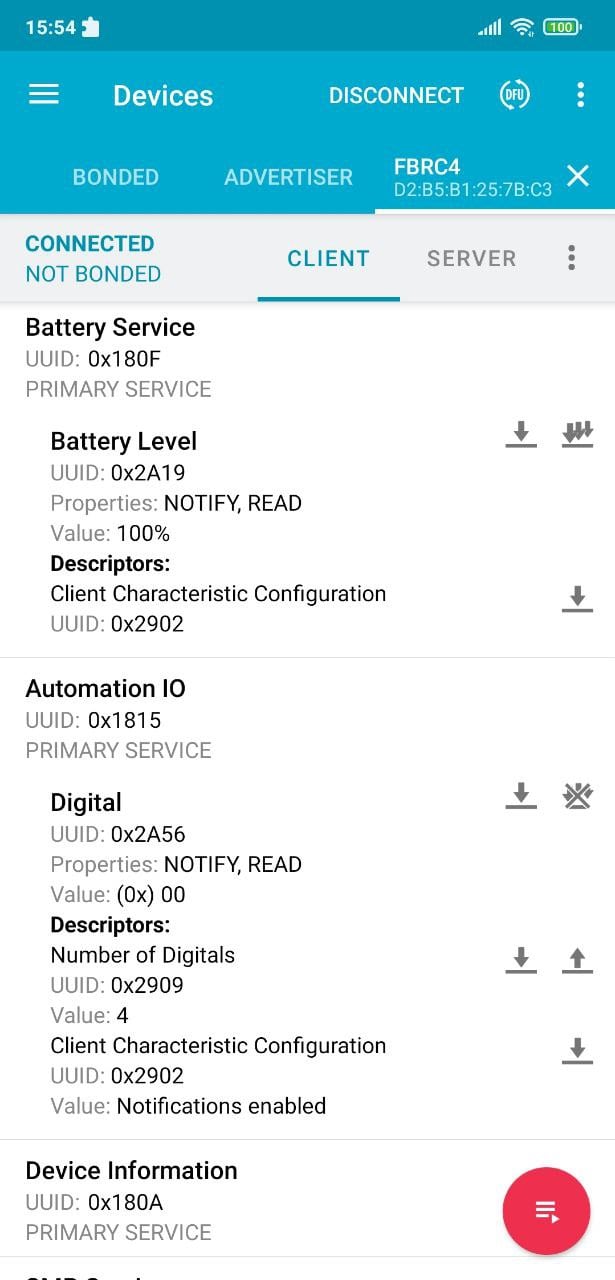
The device implements the standard Bluetooth 0x1815 Automation IO Service. The characteristic 0x2A56 Digital carries a single byte — a bitmask of button states. Every two bits encode one button, starting from the least significant. 0b00000001 means button 1 is pressed. The descriptor 0x2909 Number of Digitals declares 4 buttons. Pressing all four simultaneously returns 0b01010101. See the Automation IO Service 1.0 Specification §3.1.1 for the full state semantics. I only use 0b00 (released) and 0b01 (pressed). Notifications fire on state change, separately for press and release. This makes it possible to detect long-press, double-click and multi-key chords.
The standard 0x180F Battery Service with 0x2a19 Battery Level reports battery percent.
The Bluetooth link does not require authentication or pairing.
The device supports over-the-air firmware updates (OTA / DFU).
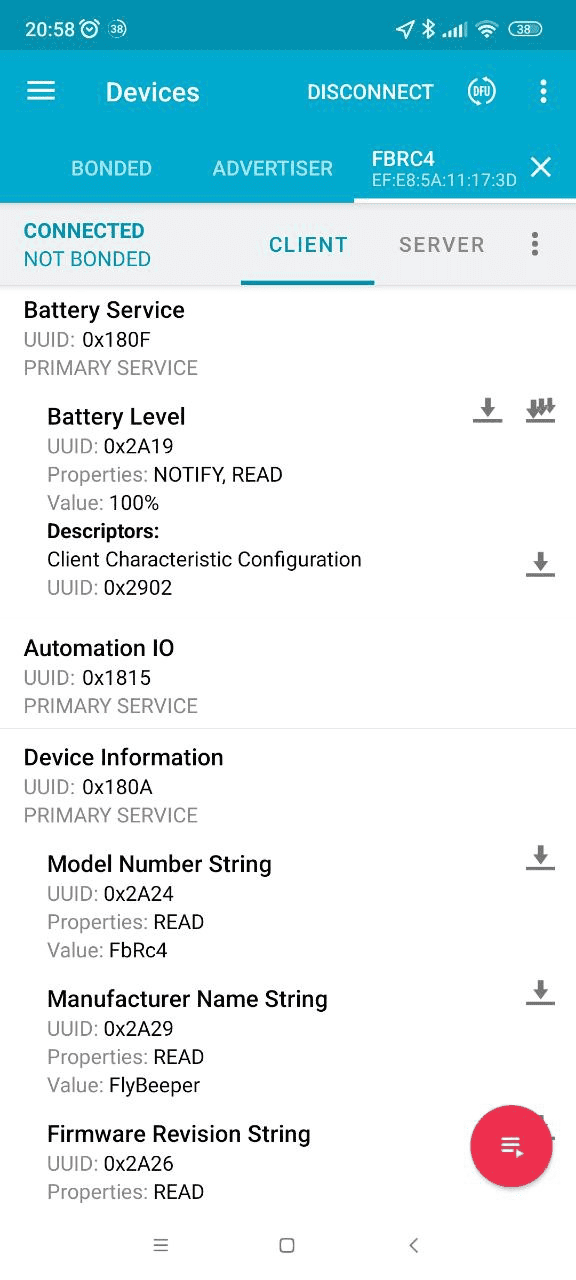 Digital characteristic (AIOS) reporting the 4-button bitmask in nRF Connect (Russian UI).
Enclosure
Made of homogeneous nylon, 30 mm in diameter, 8 mm tall.
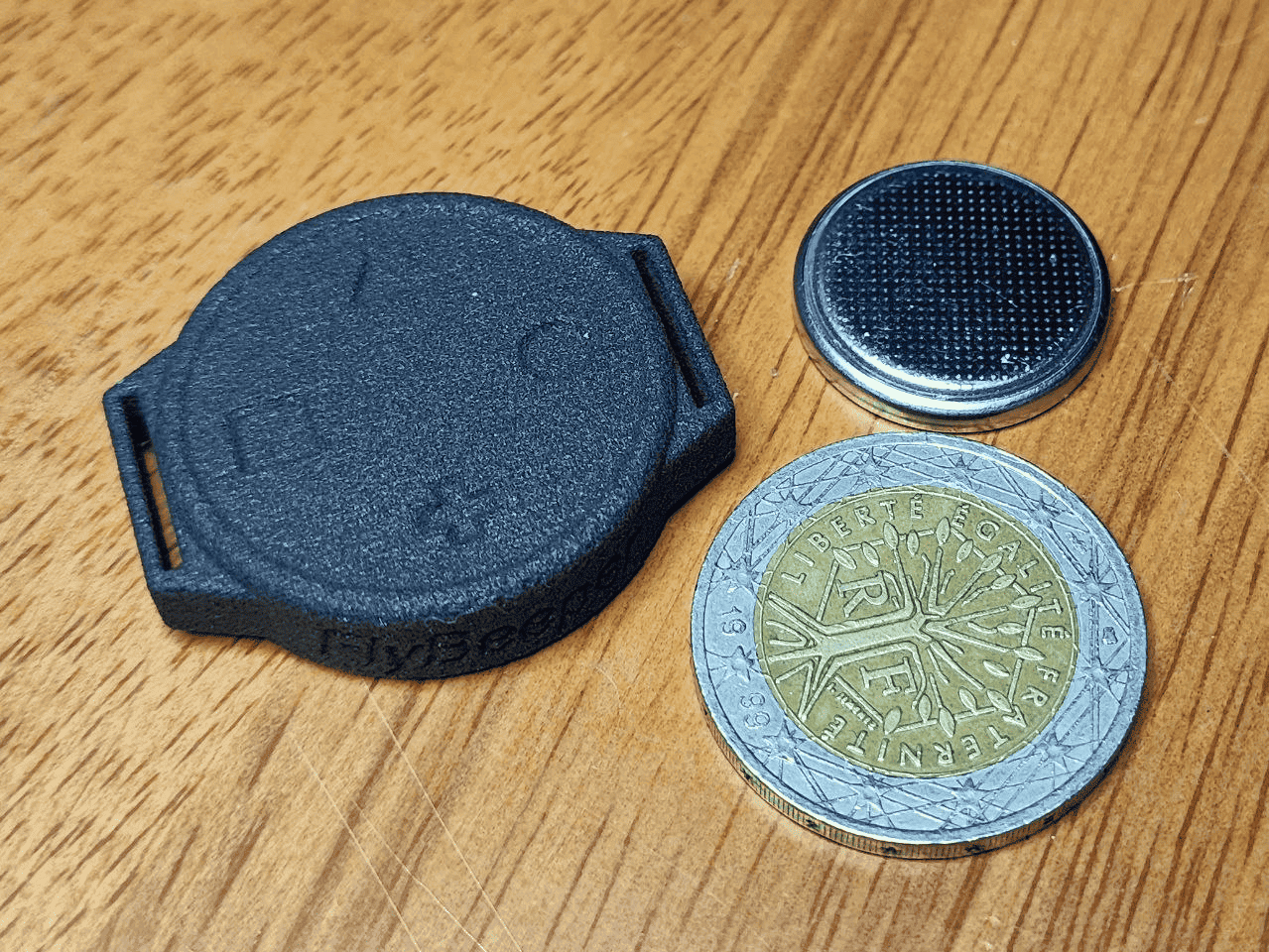 Final enclosure mounted on a brake handle.